Showing posts with label Guwahati. Show all posts

Poems by Shalim Hussain


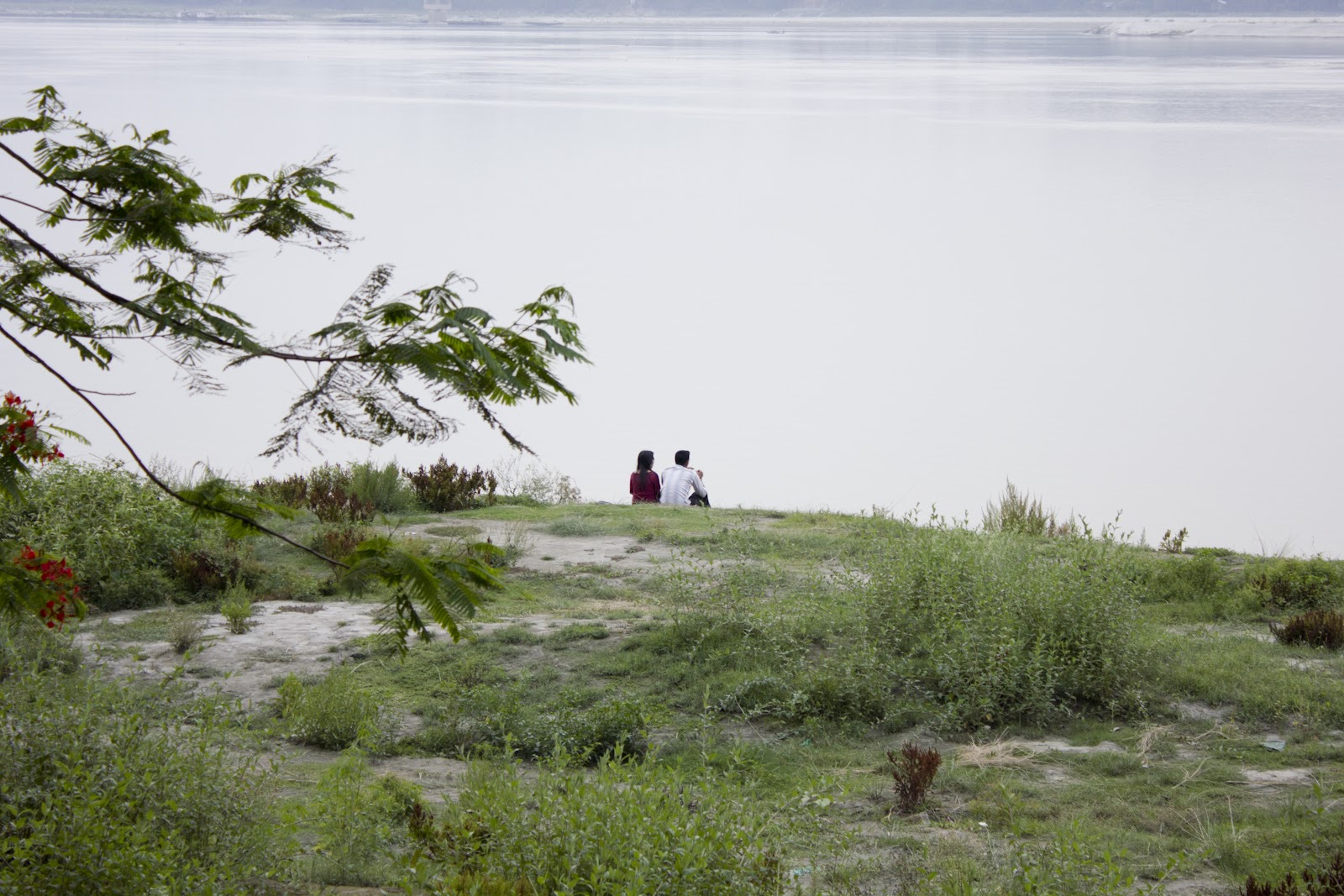
Dighalipukhuri*

One claw on a bar,
and crow
lifts the other to his lips
Blows the day’s first puff.
His view races smoke through the fencing,
conductors spank buses on-
‘Dighalipukhuri. Dighalipukhuri.’

Long pond.

He stares at a chirping he can never touch,
at entwined buds,
and pigeons floating together in air bubbles,
and lovebirds in love rows,
their heads under their wings.
His downy heart bleeds over the bliss beneath.

At home, his vulture
waits,
a spear in her hair and
a carcass in her beak.

Here he makes his day long,
sometimes swoops down and scoops up
beakfuls of love from the face of
Dighali.
Love like the blushes of hyacinths
skimmed behind boats.
The trees branded with Duryodhan’s incense,
Bhanumati’s anklets still tinkle under the
paddle-boats,
her turmeric and potfuls of milk
her wedding tears
and a few thousand years of love.

He will return to blow the night’s last mists.

*Dighalipukhuri, literally ‘long pond’, is an ancient pond in Guwahati frequented by lovers. It is connected by an underground tunnel to the river Brahmaputra and was supposedly dug for the wedding bath of the Pandava prince Duryodhana and Bhanumati,, the daughter of King Bhagadatta.


Recollections on a wintry evening.
(For Tasi)

You will be a stranger in
The city of dead fairies, she said
How could I tell her that all this drifting
Between minds and lands
Had made me one long ago?
At home, at the sheepman’s last song
‘Hai re hai, the toga’s butt is red’
And as it flapped away,
I could only see its blackness
Trailing against the winter’s white.
Stepping on the sharp grass, my
Feet cut on the edges
And blood dewed out on the silver green edges.
When segun pods burst to release
The spirits within,
I saw only dreams wafting
On feathered backs.
My neighbour was a black water tank and
A row of betel nut trees
Until one evening I wandered into our common backyard
And as cobwebs settled on my hair
And one dry leaf grafted on my forehead,
Stumbled on the lichen on two old tombs.
Today my neighbour, a straw filled
Desert cooler hugs me tight when I pass.

Then as a strange pointy haired fairy of five
I tried to blow fog to match my uncle’s cigarette tricks.
Today, I don’t wait for seasons or fog.
And when I trudge my soul up the great mosque’s steps
To cry ‘prayer is better than sleep’,
My voice beats against the wings of ghosts.

Then when the boatman anchored us on a sand bank,
And passed a sky of blue tarpaulin paper over our heads,
I smiled at two pairs of ancient teeth
Rolling up hope and damnation in a
Paper cylinder of weed.
Then sneaked out to see the river lashing and lashing again
On the nose of the boat
.
Here, I stand in rolled up pants
Seeing the rain churn up streets
Into a whirlpool of naked manholes.
And pulling my feet away from its gargling,
Open my palm for flowers
Falling as soft as teardrops.


-          Shalim Hussain, New Delhi

Funny way to find your soulmate : Siddhartha Sarma on Kenny Deori Basumatary


Chocolate_Guitar_Momos
Kenny Deori Basumatary
Tranquebar, 2011
`200, 243 pages
Paperback/Fiction
THERE are writers and then there are writers. Some focus on detail, others on language. And then there are the storytellers, who focus on the plot, colourful characters and dialogues that the reader remembers long afterwards. If a humour writer belongs to this third category, you can bet he will craft a heart-warming tale. Kenny Basumatary is such a storyteller.

I have known Kenny for quite a while, since our college days. One of the first things I noticed when I met him back then was his irrepressible sense of humour and absurdity in the face of the hard stone wall that passes for life. He hasn’t changed since then.

Today he is a multi-faceted person. Former TV news channel anchor, lyricist, composer, guitarist and actor (he stars in the upcoming Shanghai by Dibakar Banerjee), Chocolate_Guitar_Momos is his debut novel.


Joseph is your very friendly neighbourhood fellow trying to make a name as a musician in Guwahati. After a haymaker of a breakup with his girlfriend in Delhi, during which he loses his beloved bike for a song, he decides to take charge. Now, his idea of taking charge is to go looking for a girl who had smiled across the road at a bus stop on Zoo-Narengi Road eight years earlier. Good idea, says the reader, except our poor Joe does not know her name or address. Or even her face. The only thing he does recall is she was wearing a grey skirt.

But our Joe is not one to back down, so, backed by his reluctant sidekick Utpal (who would probably take umbrage if you called him a sidekick) he goes around systematically tracking down all the girls of approximately his age who went to junior colleges in grey skirts then. After one ROFL moment and another, the duo inch their way to the girl.
Reboti Chat House, Pan Bazar

Chocolate_Guitar_Momos contains not just a purely hilarious plot, but also very witty dialogues. To call it within the tradition of Wodehousian dialogues would be a trifle unjust, because they carry Kenny’s unique trademark. But there is a subtle nod to Plum when, in a discussion about likes and dislikes, our Joe discovers that a girl (I won’t tell you if she was the one) is “skilled with words, no matter in which language.” Through Joe, Kenny calls such girls “this increasingly endangered species” and we could not but agree.

And then there is the backdrop. Guwahati and, in a cameo Shillong, are never obtrusive to the plot, but there are enough word pictures for us to agree the plot could never have been set in any other part of the world. Zoo-Narengi Tiniali plays the initial unsuspecting cupid, of course, but there are also the extras, such as Chandmari, Geetanagar and Paltan Bazar police stations, where, as Utpal reminds Joseph, they would land up if they went looking for grey-skirted girls at Vidya Mandir, Maria’s and Faculty, and Swadeshi. A sort of list of places with grey skirt uniforms and also a reminder of the pitfalls.

There is a record-breaking binge by a girl at Momo Ghar, the repeated mentions of Daaju’s lusi-bhaaji which could pass for any of the numerous roadside food stalls in the city and reminded me, at least, of good old Reboti at Naag Kota Pukhuri, the different residential areas like Ambari and Chandmari that flit by as the plot progresses. It is a very clever element of grounding, of rootedness.
Where else would the mention of a traffic snarl involving an MLA’s car and an army truck – the two vehicle breeds which always have the right of way in Guwahati – invoke understanding nods from the characters? Where else would a bunch of student activists, trying to enforce a bandh of some kind, run into a group of ITBP taekwondo champs in civvies? Where else but Shillong would the characters bond even more over momos and iromba?

Alcheringa at IIT Guwahati plays an uncredited role too, in a montage of competing bands, music and hecklers. The inner workings of a band of friends, split by internal hassles, also figure here, something anyone from this neck of the woods would instantly grasp. So does mokkel, that umbrella phrase so beloved of our younger years.

Various Indian writers have made disparate attempts at humour writer, and then there is the new breed of what is called ‘IIT fiction’, about young men and women, sometimes students, about town. Most of it is so shockingly insipid that the faint of heart are well-advised to stay away from the genre. Kenny, as he would be the first to admit, is voluntarily non-IITed and Chocolate_Guitar_Momos is a class apart.

A review a few years ago by a leading national magazine of an English novel by an Assam writer had given it the thumbs down, saying it reinforced stereotypes of “‘chinks’on bikes in search of beer and beef.” A chronicler of Guwahati’s young and somewhat clueless might run into the same pitfall. Kenny, instead, by joining the tradition of those ancient men and women who told stories around tribal campfires thousands of years ago, chooses the simple, geographically rooted and humour-filled way to tell a story. And makes Chocolate_Guitar_Momos a novel to remember fondly.

Gods in Guwahati : Poems by Pranab Kumar Barman


Translator- Upasana Goswami


When you come to Jalukbari

Whenever you come to Jalukbari,
Do see me.
Knock on the closed doors of
RCC or AT houses, and ask
‘Does the lover bird stay here?’
My drunken friends will come out
And say ‘not here, not here
He lies in the midst of smoke and high,
The one reciting spring’s poems,
The one shouting slogans –
What are you scared of?
Who are you scared of?
If bordoisila wants to come
She surely will come;
It is in him there.

Whenever you come to Jalukbari,
Do see me.
I may recognise you, I may not.
Still we shall laugh
I shall ask how you are.
I will be glad if you are well
If not, I will share your grief.
Then we can talk about country,
King and sovereignty.
When the subject becomes toxic
We can come back to love.
If you don’t mind, we will drink
And blow out cigarette smoke,
Recite poems about light or life.
I will admit to you that
In this self-inflicted city exile
I am a totally unhappy man.

Whenever you come to Jalukbari
Do see me.
Do not go knocking for me
On the doors of RCC or AT houses.
The one whose looks burn
All Krishnasura trees,
The one who is lost in the
Evening market of girlie giggles,
The one who stands in the desolate bus stop –
Waiting for a dream to come by;
Ask him, ‘Are you the lover bird’?


Hazarat Mohammad

How he reached Lakhtokia from the Middle East,
I have no idea.
How did he undertake such a long journey?
Both his arms amputated at the elbows,
Leprosy-eaten toes on both his feet.
His eyes do not reflect the noon sun.
How did he come?
As he rolls over the filthy roads,
A TV shop flashes a birth-control ad.
Crowds throng the pharmacies
Looking for the string of life.
Caged chicken flutter in broad daylight.
He is the Hazarat of my dreams –
Born in Medina.

He covers one road after another,
A citizen doing the myriad tasks of life.
His Allah resides in his guts;
Under a moustache, the smiles build
The foundation of a famine-hit empire.
He cannot shun his empire –
He is both ruler and ancient citizen.
Lice roam his stench-filled body
Betelnut juice and sputum create
A multi-coloured masterpiece on it –
Pining to adorn some corner
Of a tasteful housewife’s drawing room.

Why does he roll on like this –
The world philosopher?
On Friday afternoons, when he sang ‘Allah, Allah’
It sounded like ‘hunger, hunger’.
As though he would run out to lay
Prostrate before the god of famine.
On his bare skin is etched
The long picture from Mecca to the dargah.
He crosses over the pitch-black tar and
Breaks the crowds with philosophical moves,
To rest like an eunuch by the shadow
Of a billboard, where a prostitute’s
Hair blows unfettered in the winds.
God hung himself from the sky;
Still Hazarat does not die.
Hunger increases his longing for life.
He traverses all those busy streets in Lakhtokia
‘Hindu or Muslim; the same Allah gives him!’
If you feel some pity,
Throw a coin at him.
He is the Hazarat of my dreams –
Born in Medina.


Sankardeb

Let us assume he is Sankardeb –
Writing time’s Kirtan Ghoxa on xasipat.
The footpath is his xatra.
He is meditating,
Let us assume he is planning
To draw the heavens on a hoarding
Over a bus-stop in Panbazar.
You might ask, ‘How can that be?
That sunburnt body, the tattered coat,
Listless look, long hair and loin-cloth –
I do not believe you!
His swollen abdomen, tar-black body
His clothes made of gunny bags
His knotted hair and beard,
The stench from his body; his sunken eyes –
He cannot be, he cannot be… thoo!’

Imagine Sankardeb is six hundred years old.
While coming upstream from Kochbehar,
He saw victory and defeat in wars
He saw the fugitive king, the treaty of Yandaboo;
He saw Patharighat and Kushal Konwar’s hanging,
He saw the struggle for independence
And proliferation of opium.
He saw both the death of language and the birth of Jonaki;
Slavery of the poets and the language movement, the great depression
He saw rape, lathi-charge, gunshots and partition riots,
He saw corruption and the buying and selling of jobs.
The changing face of law in courts;
The ones without flesh, the ones without roots,
He even saw fashion shows and blue films.
Experienced hunger in Dhokuakhana
Saw long lists of martyrs’ names
And false reports of journalists.

Seeing these he went insane, dumb, deaf and blind.
He exiled himself to the footpath of Ashwakranta
Here he is Krishna, resting.
He became hungerless, above cold and numbness,
He became sleepless, derelict, beyond pain.
The history of six hundred years
Made him a god –
A wealthless god, a eunuch god.
You cannot say he is not Sankardeb,
It was he who gave you a lifetime’s beliefs.
You cannot despise his despicable living
As it was he who said, ‘Dog, fox, donkey,
All are manifestations of Ram’.
Let us assume he is Sankardeb –
Nobody stands to gain or lose.

Culture, commerce, compromise: Which way Guwahati? : Uddipana Goswami

Uddipana Goswami traces Guwahati’s journey towards consumerism and corruption and suggests culture and literature can save the city’s soul.

 
You could find salvation in Guwahati
for your consumerist soul, or lose
your self in the dark shadows
accentuated by its dazzling lights
I HAVE written many times about the many Guwahatis of the mind – how the city is its own place and yet, takes on a different meaning for the different people who live in it, write about it, and engage with it in various ways. In my childhood years, I was oblivious to the pains of growing up that my city, my sister, was going through.
Already a woman,
Wounded, shot, raped, violated,
Pretending to be a child
Holding hands
Leading me away from herself
So I would not feel
Your pain so early.

Much later, in an effort to understand her better, I followed the poet Nilim Kumar, as he
…flounders around
In alleys and footpaths, under sewers
In storehouses in the dark, amidst the cacophony of motor cars

I tried to acquire the same empathy which does not allow him to

…turn up his nose even at the maggots wriggling
On carcasses in alleys and sewers in the darkness
Beneath the footpaths…

Beneath her ‘layers of filth, a thousand years old’, I marvelled at Harekrishna Deka’s

…scintillating
Silent lover
Under a green veil of pat

I also tried to come to terms with the neurosis of Sushil Duara in Silabhadra’s ‘Smog’. In that short story, Duara cannot reconcile with the contemporary violent history of an insurgency-ridden Guwahati. The mindless violence that scars a familiar landscape drives him to insanity. I had also seen and felt this insanity, this paranoia, creep into the minds of many of the old inhabitants of the city. These are the middle class professionals like my parents who migrated from villages and mofussil towns, for whom security of life and property was of paramount importance. Anything that threatened to destabilise their carefully organised lives – be it insurgents who made political statements through bombs and bullets or the state’s armed forces stationed on the pavements outside their houses, leering at their girls  or slapping their boys just because they were walking by – seemed terrifying. They had come to Guwahati when it was still confined to the riverfront of Uzan Bazar or the bookshops of Panbazar or the commercial areas of Fancy Bazar; when places like Bamunimaidam, Beltola and Azara did not have concrete edifices but paddy fields and wetlands. Like the middle class everywhere, they gave the city the best and the worst – the narrow-minded spy-next-door as well as the greatest of emancipated literary minds, the habitual apathy of indolence as well as the mass participation in the Assam Movement of the 1980s.
A city is a living, breathing organism, and it will always have its inherent contradictions. During the last 15 years of self-imposed exile from the city, every time I have been back for any length of time, I could always feel these contradictions growing enormously. The last time – and the longest – I was here for more than a year at a stretch, I got to know the new Guwahati more closely. I saw how Guwahati was fast getting over its initial fears. There was just too much money (thanks to insurgency, counter-insurgency and what have you) and too many opportunities for Guwahatians to have any reason to complain against the State.
This time when I am back again to stay, I get to know that ‘New’ Guwahati is no longer the old address near Bamunimaidam where my bank has a branch. It is the Guwahati-Shillong (GS) Road with its swanky new look, multi-storied malls housing the largest brands, upmarket eateries and yuppy hangouts. The Chandmari flyover is no longer the mecca for all young lovers, there are other hangouts that ensure more privacy and intimacy. The people I meet ask each other ‘Where are you from?’ instead of ‘Whose house do you belong to?’ as was wont in a city where everybody seemed to know everybody else. Conversations veer around ‘Pizza Hut tonight or Khorika?’ instead of ‘Should we cook mas tenga today or simple alu pitika?’ After work, one friend does not remind the other it is his turn to bring home a ‘half’ today – because his wife was cooking pork and xukan mas for dinner and that was more than enough.
Guwahati today is no longer the city that could be your kin or your lover. It is an evolving urban sprawl, chaotic and mismanaged like any other. You could find salvation here for your consumerist soul, or lose your self in the dark shadows accentuated by its dazzling lights. What would the poet have to say today? I do not know, but I do feel that the key to Guwahati’s future course of development lies somewhere between poetry and politics, between culture and commerce.
As the gateway to the entire northeastern region, Guwahati needs to be many of the things we hate about it. Its commercial character is perhaps as much a result of natural evolution as of its centrality in the Northeast. After all, if Pantaloons opens a showroom beyond Ganeshguri and nearer to Shillong, we do find people coming down in droves from the neighbouring hill city, disembarking at the mall, going on a shopping spree and returning home the same day without entering the rest of the city. Guwahati has to cater to the region at large in the absence of a similarly large enough, similarly accessible urban centre elsewhere. For instance, the escalating sales of cars – 32,000 vehicles were reported by Seven Sisters Post as registered in Guwahati between 1 April and 30 September 2011 – are as much a result of demand within Guwahati city (witness its clogged roads and constant traffic jams) as of demand from all over the Northeast. If the smoke from these cars has clouded the city’s soul, the same smoke-screen of counter-insurgency money also envelops the entire region. In an effort to co-opt the revolutionary propensities of the disgruntled peoples of the region, the Indian State ensures a steady flow of finances – whether through official channels or unofficial – so that corruption and consumerism can overshadow cultural and ethnic aspirations.
The truth that the entire Northeast shares the same fate – thanks in large measure to insurgency, militarisation and misgovernance – is nowhere more clearly manifested than in the writings by authors in and from the region. Conflict is a common thread in most of these writings which are finally a means of coping with the violent and chaotic history of our times. As the city that reflects this commonality, as well as the setting that can give the penned-down collective experiences a commercial outlet, Guwahati then should also act as the literary and cultural hub for the region.
There is no escaping the truism that literary products are finally commodities to be traded in. The challenge is to provide them with an ideal locale where the trader (in this case, the publisher), the craftsperson (the author) and the consumer (the reader) can come together in synergy. The aim should be to give the publisher her profit, to ensure the author her due – both in terms of commercial success and a discerning audience – and to provide the reader with a platform where she can choose which product gives her the best value for money. All of this Guwahati can and should provide.
Many literary events in fact are being organised or are underway in Guwahati. The Anwesha Children’s Book Fair (6-8 November) brought together school children and teachers, publishers of children’s literature and readers of the same. While the North East Book Fair which started on 14 December will go on till 27 December, the North East Foundation is also planning a Guwahati Literary Festival on 6-8 January. All of these events have or will see participation by national and international literary organisations and individuals. At a time when the demand for the literature of the Northeast is on the rise, the city should try and cash in on such fairs and festivals to turn its image around. From being the corruption and commercial capital of the region, perhaps it is time now to establish Guwahati as the cultural and literary heart of the Northeast.